CASA DIVERSA
Refurbishment #Prototype
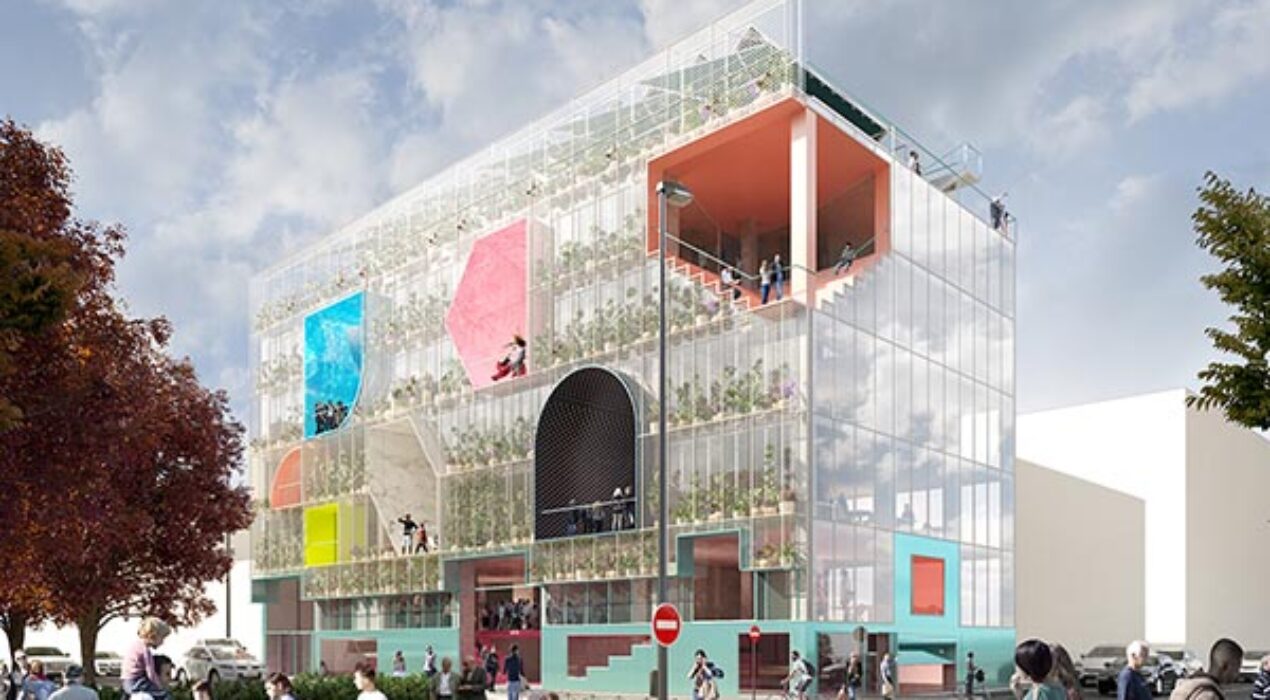
109 · casa diversa Diverse knowledge Space prototype, feasibility study for the new headquarters of the FDNC, Madrid ABSTRACT*This is one of three spatial prototypes in the interdisciplinary process for carrying out a feasibility study to build the new headquarters of the Daniel and Nina Carasso Foundation (DNCF) in Madrid. Rising behind a canopy of trees, an upright vegetated plane hosts a number of cut-out spaces suspended in floating equilibrium. At its base, several openings of varying sizes engage the street. A pergola of fabrics and photovoltaic panels covers the terrace and completes the volume above. The refurbishing strategy for this 1960s building begins by consolidating the preexisting reinforced concrete structure and opening up singular spaces of different geometries, sizes, materials, and colours. This array of “elevated courtyards” provides ventilation and natural light inside this nearly fifteen-metre-wide block closed off by a party wall in the back and on the south side. Looking out on the adjacent green area, the “exterior rooms” act as multipurpose and leisure areas. They also act as waypoints along an architectural promenade complementary to the basic flow of foot traffic in the building. Through this itinerary of indoor and outdoor atmospheres, hard and soft, of […]
Read More ›

SUPER PETITES MAISONS
publication #fictionarchitecture
136 · SUPER PETITES MAISONS Learning From Fiction (2) ABSTRACTResearch: Fiction Domestic Spaces (Vol.2) This publication forms part of a collection of domestic architecture-fiction projects and expands on the research begun in the first volume of this series titled What is Home Without a Mother. It therefore continues with a collection of domestic spaces that, despite their often not having been designed by architects, do however constitute true testing grounds for domesticity and yet with few exceptions, they have hardly been received by histories of architecture. While in the previous volume we focused on three architectural cases were encompassed in the infrastructuration processes of modern cities in the early 20th century to look into the impact of these new technologies on domesticity, we now turn to new questions. What is the relationship between architecture and desire? How is desire handled from architectural space? How does desire go through the spaces and bodies that inhabit them? Is desire an architectural material? What architectures do we use to weave our worlds of desire? To explore this problem, we looked at libertine fiction that had its heyday between the 18th and 19th centuries. We feature three architectures of fiction based on works […]
Read More ›

MIMOSA
single house #offthegrid
125 · MIMOSA Off-the-grid Hedonism Restricted design competition for an ecological house in Mimosa - Plot 39 ABSTRACTThe project is based on a twofold objective: to imagine a dwelling that is self-sufficient and environmentally friendly and hedonistic to boot. "Ecology" and "pleasure" need not be at loggerheads. Our entry is developed under a sweeping "landscape" roof made up of natural elements (native plants) and artificial elements (solar panels), whose folded geometry solves a number of issues: gradual adaptation to the slope of the land; framing the views towards the landscape from the rooms; adding natural overhead light at specific points through skylights; creating shade houses at the entrance and on the terraces; an optimal orientation for producing energy throughout the year; and controlling solar radiation by shedding it in summer but allowing it in in winter. Under this great "energy blanket", the domestic program unfolds, arranged on different levels. The terraced section generates a flowing space that activates diagonal views and minimises the transit spaces, fostering the continuity of every room with the land by means of the terraces. The compact configuration of the volume improves the form factor and optimises its energy efficiency. At the centre of the floor, […]
Read More ›

CYBORG GARDEN / IMNA
exhibition #cyborggarden
119 · jardín cyborg / imna Strategies for adapting to climate change ABSTRACTCuratorship and display design for the exhibition ‘Cyborg Garden – Mutant Institute of Environmental Narratives’, Matadero Madrid “Your attention please. You are now entering the Mutant Institute of Environmental Narratives. A platform for generating knowledge and artworks as a means to address the challenges presented by the climate crisis in the 21st century. A place for communicating with other species, for learning from ants and many-headed slime mould and for talking with humans who have not as yet been born. We invite you, firstly, to a preview of the prototypes of the future Cyborg Garden now being developed by a team of artists, designers, architects, scientists and specialists in various fields and which will soon be planted in Matadero Madrid. After that, you will be able to visit the exhibition Eco-visionaries. Art for a Planet in a State of Emergency, in which over 40 creators tackle climate change through art. We also encourage you to take part in the various activities that will be held in this mutant space over the coming four months. Welcome.” - The exhibition ‘Cyborg Garden – Mutant Institute of Environmental Narratives’ shows […]
Read More ›

UHF
000 · uhf Asociación para la Investigación Contemporánea ABSTRACT* Included in the Archive of Creators of Matadero Madrid UHF is a publishing project developed by the same-named group in the late 1990s and the early 2000s. UHF was interested in questioning and pushing the limits of architecture. It was configured as a channel for publishing different contents: an Ultra High Frequency (UHF) support open to interference from different disciplines. Each issue of UHF was structured around a theme that guided both the selection of the content and the design of the container. In one way, the different materials published create a patchwork of documents that allows us to sketch out the subject matter through a polyhedral approach. In another way, each issue becomes a small "object of desire": the different formats (ranging from a package of vacuum-packed ham to a giant soap bar, a set of tokens, a golden labyrinth or a collection of videos) invite the reader to immerse himself in the publication, turning the reading experience into an initial approach to the problem. It followed a few basic rules: - 1) Discard any content that has previously been published in any other media, unless in Japanese magazines […]
Read More ›

HOM SIEOTEO
domestic prototype #domesticfictions
101 · 홈 시어터 - HOM SIEOTEO Domestic Prototype for Next Home, Seoul Living (in) black boxes ABSTRACT Hom Sieoteo is a prototype of a home designed for Next Home (Seoul, 2017)*, conceived as a domestic theatre where day-to-day fictions can be activated. Our every day lives are a sort of soap opera. Therefore, this "domestic black box" is designed as a transformable stage, enabled for the choreography, rehearsal, action and fiction of daily life. Its spaces are equipped to intensify the performing experience of the users’ bodies, to test and question their social roles, to rehearse their shared imageries, to test their subjectivity and to explore the potentiality of the ordinary. This project hinges on a dual strategy: on the one hand, a simple distribution optimises the functionality of this small 50m2 space. On the other hand, the walls, ceilings and floors are fitted with a series of devices that allow multiple domestic configurations: sliding panels, hatches, secret spaces, fold-down mechanisms, furniture that hangs from the ceiling and are actuated by mechanisms, etc, that allow dwellers to deploy different domestic settings in the apartment. Hom Sieoteo is configured as a performing black box, a ‘domestic theatre’ where dwellers […]
Read More ›

P.N.S GENERAL VARA DEL REY
PUBLIC SPACE #OPENBLACKBOX
037 · P.N.S GENERAL VARA DEL REY Opening the Black Box ABSTRACTPilot Project for the Proyecto Madrid Centro * Selected Work, Holcim Awards for Sustainable Construction, 2011 General Vara del Rey square is a popular spot in downtown Madrid, and its claim to fame stems mainly from the Rastro street market that is held there every Sunday. This project integrates a solar farming power infrastructure within the city centre, redefining the environmental policy by means of a social-technical hybrid. The generated power shall be channelled to the network through a single connection point. The economic profit shall be used to pay for the square. The design proves how integrated technical facilities provide a chance to not only improve the power performance of cities but also to allow citizen participation in the power management processes. Energy facilities are both an urban infrastructure and a means of communication for citizens. The square is an interface that explains the power production and management and translates them into spatial codes by means of various indicators that are integrated within the technical devices. The information is translated from an expert data language to easy formats that the public can read.PROJECTPilot Project for the Proyecto Madrid Centro […]
Read More ›

WHAT IS HOME…
PUBLICATION #FICTIONARCHITECTURE
079 · what is home without a mother Living in a Black Box ABSTRACT* XIII Bienal Española de Arquitectura y Urbanismo Award, category - divulgation, 2015 Research: Fiction Domestic Spaces (Vol.1) 'What is Home Without a Mother', is the first volume of a research done by elii on some classic fiction domestic spaces: spaces which despite being seldom the brainchild of an architect, are nevertheless true testing grounds for domesticity and are capable of challenging the prevailing disciplinary narratives. Case studies: El hotel electrico, Segundo de Chomon, 1908, The Sacrecrow, Buster Keaton, 1920 and The Electric House, Buster Keaton, 1922.PROJECT* XIII Bienal Española de Arquitectura y Urbanismo Award, category - divulgation, 2015 Research: Fiction Domestic Spaces (Vol.1) 'What is Home Without a Mother', is the first volume of a research done by elii on some classic fiction domestic spaces: spaces which despite being seldom the brainchild of an architect, are nevertheless true testing grounds for domesticity and are capable of challenging the prevailing disciplinary narratives. Case studies: El hotel electrico, Segundo de Chomon, 1908, The Sacrecrow, Buster Keaton, 1920 and The Electric House, Buster Keaton, 1922.CREDITS Architects: elii - Uriel Fogué + Eva Gil + Carlos Palacios Colaboradores: Pedro P. […]
Read More ›

T.O.P.S
Urban Prototype #tecnificandolopúblico
084 · technologies of the public sPACES Europan Competition, Zagreb, Croacia ABSTRACTEquipment for the public enjoyment of the banks of the river Sava Let’s imagine a set of interactive technologies that give us the chance to speculate experiment with public spaces, opening them up to the potential for unsuspected situations. 'Technologies of the public (spaces)' is an ensemble of devices that create liveable spaces that can be endlessly and untiringly explored and re-imaged, refusing the strictures of permanent and stabilised programmes. The proposal emerges as a powerful city-making machine in which it is possible to explore, speculate, imagine and test other ways of sharing the city, other political ecologies, other urban metabolisms, other forms of building communities, other forms of establishing material and emotional attachments, other forms of experimenting with the urban, other forms of political participation. The project is based on a dual strategy: A) Landscape strategy. Structuring of the various sites along the river, integrating the plots into the existing urban fabric and into the future urban developments that are projected for the area. An ensemble of paths, bicycle lanes, leisure and sport areas along the banks of the Sava will grant Zagreb a new horizon. B) […]
Read More ›

AKA LUNAR HOUSE
Single House #aliciaframis
054 · aka lunar house Hospitality of the Foreigner ABSTRACTHouse for Alicia Framis in The Land Foundation, Chiang Mai (Thailand) The Land Foundation community is located near the village of Sanpatong, a 20 minute car ride from Chiang Mai, Thailand. The land, originally full of rice paddies, was bought by a group of artists in 1998 and was given a new use as a retreat, a place for thought and debate, ruled by anonymity and dispensing with the concept of private property. The real project in The Land Foundation is the community itself and its way of life. In order to do that, it invited several artists from around the world to undertake architectural projects that would enrich the development of the community, such as Philippe Perreno and Francois Roche’s Hybrid Muscle, or Kamin Lerdchaprasert, Superflex, Tobias Rehberger y Rirkrit Tiravanija’s kitchen. Elii was entrusted by Alicia Framis to design the Aka Lunar House, a space where to rest and live within the community. The Aka Lunar House Project adapts to the environment’s weather conditions. It is located near a wooded area that, on the one hand, protects it from solar radiation and, one the other, avoids any additional […]
Read More ›